

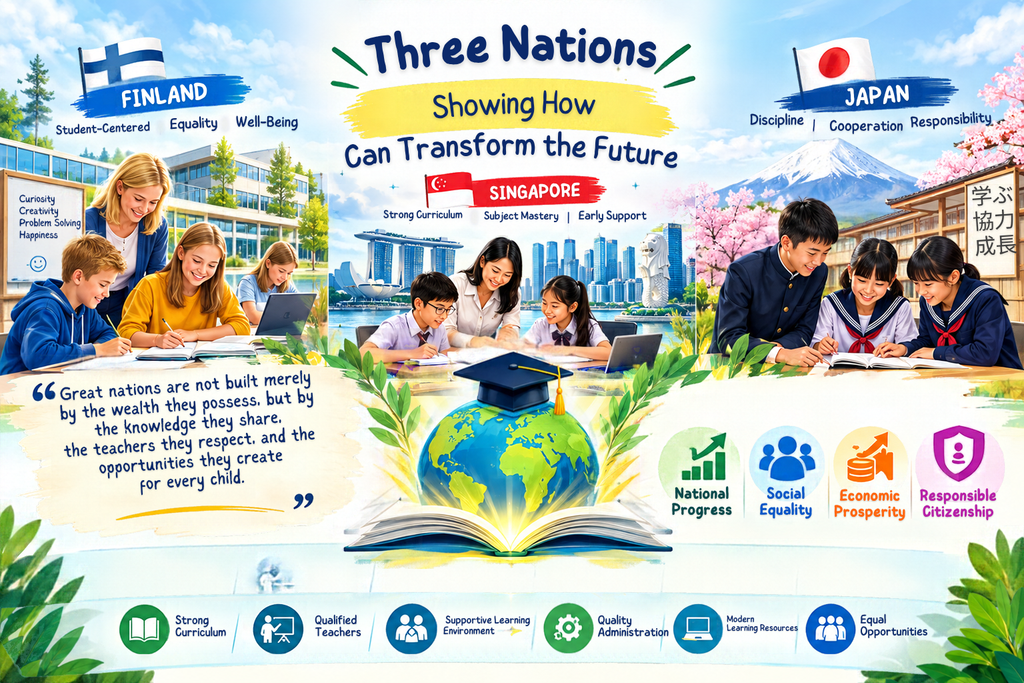
“Great nations are not built merely by the wealth they possess, but by the knowledge they share, the teachers they respect, and the opportunities they create for every child.”
Education is the foundation of national progress, social equality, economic prosperity, and responsible citizenship. Around the world, several countries have developed educational systems that offer valuable lessons for improving the quality of learning and preparing students for the challenges of the modern age. Among the most admired examples are Finland, Singapore, and Japan. Although these countries follow different educational approaches, they share a commitment to strong foundational learning, capable teachers, organized curricula, and continuous improvement. Their experiences demonstrate that an exemplary education system is not defined only by examination results or international rankings. It is also measured by students’ understanding, creativity, confidence, discipline, practical skills, and ability to contribute positively to society.
The strength of these three systems lies not in one single teaching method but in the way curriculum, instruction, assessment, and student support work together. Finland emphasizes broad learning, interdisciplinary activities, and student well-being. Singapore places considerable importance on clearly sequenced learning objectives, subject mastery, and the early identification of learning difficulties. Japan combines structured subject instruction with collaborative learning, classroom routines, and character development.
Strong Curricula, Subject Management, and Teacher–Student Relationships
Instead of introducing disconnected facts, teachers explain how new ideas relate to concepts students have already learned. Students study multiple subjects through organized timetables, age-appropriate workloads, and planned learning outcomes. Teachers use assignments, classroom discussions, quizzes, projects, and other forms of assessment to monitor understanding and adjust instruction. The objective is to complete the required syllabus without reducing learning to a race through textbook pages.
Respectful communication, clear expectations, constructive feedback, and timely academic assistance help students feel confident enough to ask questions and learn from mistakes. Strong teacher preparation, professional collaboration, well-designed learning materials, effective school leadership, and consistent public investment all contribute to educational quality. However, each country has its own challenges, and no system eliminates every learning difficulty. Their shared lesson is that curriculum completion should be accompanied by genuine understanding.
An Education System Built on Trust, Equality, and Understanding
Finland is widely recognized for its student-centered approach to education, emphasis on educational equality, and professional respect for teachers. Its schools generally focus on helping students understand concepts instead of simply memorizing textbook passages. Learning activities encourage curiosity, independent thinking, cooperation, and problem-solving. Teachers have professional autonomy to adapt lessons to their students’ needs while working within national curriculum guidelines. Students receive guidance and additional support when they experience difficulties, helping them progress without unnecessary pressure. Finland’s approach also values student well-being, balanced workloads, and meaningful feedback. Rather than treating every child as identical, the system recognizes that students have different strengths, learning speeds, and interests. These principles make Finland a valuable example of how high educational standards can be combined with fairness and a supportive learning environment.
Government education departments are maintaining consistency, fairness, and long-term educational development. In Finland, national authorities establish curriculum frameworks and broad educational objectives, while municipalities and local education providers play important roles in organizing schools and delivering education. This combination provides national direction alongside local flexibility.
An Education System Rooted in Discipline, Cooperation, and Responsibility
Japan offers another influential model by combining academic learning with social responsibility, classroom cooperation, and the development of good habits. Students study a broad range of subjects, including language, mathematics, science, social studies, arts, and physical education. Schools also provide opportunities for students to develop independence, respect for others, teamwork, and responsibility for their shared environment. In many schools, students participate in classroom cleaning and other communal activities, helping them understand that education involves character development as well as academic achievement. Japanese teachers generally follow national curriculum standards while adapting classroom instruction to students’ learning needs. Lesson study, in which teachers collaboratively examine and improve their teaching, is another important professional practice. Japan’s approach illustrates how consistent expectations, supportive school communities, and a strong sense of collective responsibility can contribute to educational quality.
Government and Private Schools: Equality, Choice, and Quality
The relationship between government and private schools differs across Finland, Singapore, and Japan.
Singapore has a substantial government-school sector alongside government-aided, independent, and other privately operated institutions. Government schools are important components of the national education framework, while some alternative institutions offer different program or levels of independence.
Japan likewise has a large public-school sector and a private-school sector, particularly in certain secondary and higher-education pathways. Public schools follow national curriculum standards, while private institutions may provide distinctive educational environments within the applicable regulatory framework.
These countries demonstrate that government and private schools can contribute to a strong education system when academic standards, qualified teachers, student welfare, and accountability are taken seriously. Nevertheless, their arrangements are not identical, and differences in fees, admissions, school resources, and educational pathways remain. The wider lesson is to ensure that a child’s educational opportunities do not depend entirely on family income. Governments can pursue this goal through adequate school funding, fair admissions policies, learning support, transparent standards, and targeted assistance for disadvantaged students.
Why Other Countries Should Adopt These Educational Principles
Countries seeking educational reform can learn much from Finland, Singapore, and Japan. The most effective approach is not to reproduce an entire foreign system, but to adopt its strongest principles and adapt them thoughtfully to local circumstances. Educational reform should be planned as a long-term national commitment rather than a short-lived political initiative.
First, governments should develop a clear, coherent, and regularly reviewed curriculum that emphasizes foundational knowledge, conceptual understanding, practical application, and critical thinking. Syllabus completion targets should be realistic, and schools should have enough time to explain difficult concepts, provide revision, and address learning gaps. Students should study a balanced range of subjects without facing excessive workloads or unnecessary repetition.
Second, teacher quality must become a central national priority. Teachers need rigorous initial preparation, continuous professional development, fair compensation, suitable classroom resources, and respect for their professional expertise. Training should help them manage mixed-ability classrooms, use technology effectively, assess learning fairly, and build constructive relationships with students. Education departments should evaluate teaching in ways that encourage improvement instead of creating a culture of fear.
Third, governments should reduce the quality gap between public and private schools. Public institutions require reliable funding, safe buildings, clean drinking water, libraries, laboratories, digital access, and sufficient qualified teachers. Financial assistance and targeted learning programs should help children from low-income households, rural communities, and other underserved groups. Private schools should also meet appropriate educational, safety, and accountability standards.
Fourth, curriculum authorities, textbook authors, and publishers should work together to produce accurate, affordable, inclusive, and practical learning materials. Textbooks should be reviewed regularly, while teachers should be encouraged to supplement them with relevant activities and digital resources. Governments should establish transparent textbook quality standards and ensure that commercial interests do not outweigh students’ educational needs.
Fifth, education departments should coordinate reforms across curriculum design, teacher recruitment, examinations, school funding, and student support. Policymakers should collect reliable data, consult school communities, publish progress reports, and use independent evaluations to identify what works. International benchmarks can provide useful guidance, but reforms must reflect local realities and be adjusted when evidence shows that a policy is ineffective.
Finally, education systems should recognize that success involves more than marks, certificates, or examination rankings. Students need knowledge, integrity, confidence, creativity, emotional resilience, communication skills, and the ability to work with others. Schools should prepare young people for higher education, employment, entrepreneurship, responsible citizenship, and lifelong learning.
Conclusion:
The experiences of Finland, Singapore, and Japan show that educational excellence grows through sustained investment, capable teachers, thoughtful curricula, effective administration, high-quality learning materials, and a shared commitment to every child. Their systems are different, yet each offers practical lessons for countries seeking to improve educational access and outcomes. The greatest opportunity lies in adapting these lessons rather than copying them blindly. Governments, teachers, parents, authors, publishers, and communities must work together to create an education system that combines academic standards with fairness, discipline with creativity, and national priorities with global readiness. When reforms are evidence-based, consistently implemented, and open to improvement, education becomes more than a route to employment: it becomes a foundation for stronger communities, a more productive economy, and a brighter future for generations to come.
Very true
Agreed